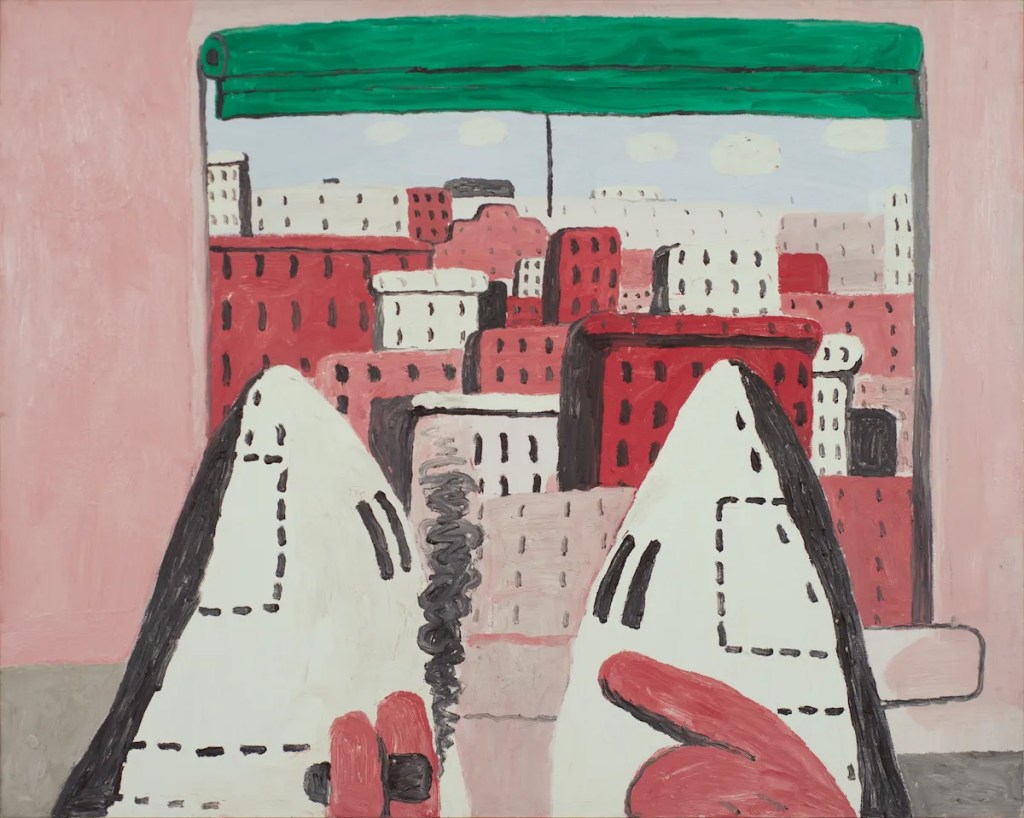
Philip Guston, Open Window II, 1969.
I remember being confused as a fourth grader, beginning my state-mandated standardized test and knowing that I was expected to circle the bubble that says “white” under “ethnicity”. I didn’t have the words for it at the time but, at the most basic level, I knew that I was being asked to self-identify as something that I was not. While that may sound inflammatory coming from a person who would clearly be identified as “white” in American society, my hope is that you may be willing to consider a different viewpoint by the end of this essay.
My embodied feeling of incongruence was due to my experience that I was being asked to sign onto the program of dividing all the kids in my school up into “white” and “everyone else”. A request for my compliance confronted me in the bubble marked “white”. I didn’t like it. I didn’t like the way it felt for the adults to tell us that some kids were different from other kids, with strange, unclear rules and expectations attached to those differences. I still don’t like the way that I was expected to categorize my lived experience, however I now understand much more about the cultural phenomenon that I was confronted with in that moment.
While we are told to think of “white” as an ethnicity, it is not. It is not the heritage of the collective wisdom of one’s ancestors, nor is it the land that they came from. Rather, it is the defining side of a dualistic power structure that inflicts perpetual violence upon people. This is the dualism of “white” and “not-white” in American society, both historically and today. There’s no shortage of words that have been used to diminish and demean the humans placed into the “non-white” category across the span of centuries of racist violence.
If one desires to respond to this situation compassionately, it’s crucial to understand what “white” means in American culture, and how one’s appearance interacts with a shared story that privileges “whiteness”. It’s also essential to consider the ways that this shows up in the minutes of one’s life, and to be curious about the ways that this shows up in other people’s lives.
However, to self-identify as “white” in America, keeps the process stuck within a dualistic self-understanding that is unavoidably violent. Self-identifying as “white” is to identify with the structure itself, a structure that is fundamentally about making people “other”. It’s about alienation and distance. To identify with this story is only helpful as a way of recognizing one’s direct experience in a process of unfolding broader human connection and acceptance.
This doesn’t mean that we can’t communicate about “whiteness” specifically and concretely. Someone can choose to not self-identify as “white” while still recognizing that they are treated as “white” within a system that imposes “whiteness” on all its subjects.
What the current popular social justice advocacy narrative often misses is that the imposition of “whiteness” is inflicted upon each and every person in American society. This violence is traumatic to all, no matter which side of the power dichotomy they are sorted into. With consideration that this essay is in dialogue with informed perspectives on the way that this violence occurs for those who are labeled as “non-white”, I want to cover how it looks for people placed on the side labeled as “white”. I believe that significant parts of this trauma remain concealed in progressive American culture and that, as a consequence, the communal process of social healing is frequently interrupted.
To be told that one is “white” is to be specifically told that your life is more valuable and worthy of compassion than the lives of other humans. This is a lie so entirely mischaracterizing of the nature of human existence that it inflicts a trauma upon each person that it is imposed upon. This is the meaning of “white” in the context of American culture and it is also at the core of the thinking that allows for racism. Someone can be told the story that they are “white” for their entire life, yet it will make the story no less a lie about the fundamental nature of who they actually are. It will always be a lie. Identifying with that lie will keep a person stuck.
Consider two different responses to the question: How has the dualistic racist social framework of American culture affected you?
- All my life, I’ve been treated as “white”. This meant that I was told that I was better and more important than other people, as a fundamental characteristic of who I am. I know that story was a lie and I’m familiar with, and relate compassionately to, how it wounded me. I wish to relate to each person who has been traumatized by this same system with curiosity and compassion.
- All my life, I’ve been white. I identify as a white person. It’s an injustice that white people have perpetuated violent structural racism against Black people for centuries. It’s my responsibility, and the responsibility of all white people, to make it right. My experience is fundamentally different from the experience of Black people because I identify with the privileged side of historical racism. This is the way to make progress. Additionally, I feel a great deal of guilt and shame about the history of racism in America. It’s important that I don’t make the shame about me. To focus on my experience of shame directly and to seek out lots of direct support for it would be privileged and self-indulgent of me. Instead, I hold my unhealed shame as a badge of honor and use it to motivate myself to work harder towards helping people who I see as less privileged than myself. White people who don’t think about it this way need to check their privilege and their internalized racism because they are being racist. I know this for a fact.
One could argue that the voice at the end of the second answer is a bit “too self-aware”, and I’d agree. What I’m attempting to illustrate is a misunderstanding, caused by the racist framework itself, that interrupts someone’s ability to contact their lived experience directly enough to allow it to change and transform, to continue forward in an unfolding process of increased awareness.
Notice also that while the person in the second response is able to indicate awareness that their experience is radically different from the people whom they consider to be “Black”, this dialogical approach is only applied selectively. This person doesn’t think of themselves as fundamentally different from people they would consider to be “white”, with the same level of imagined space for difference. One indication of this is to impose any kind of universal external responsibility on a perceived homogeneous group of people (i.e. “its the responsibility of all white people to repent and make things right”). This is not dialogical.
This person might plan meetings with only other “white” people where they talk at length about how to best help marginalized people to “fix” racism. In doing so, the person would continue to strongly identify as “white” and to further distance their own experience from that of people who they would perceive as “not white”. This person might explain their actions with a misunderstanding of the truth: “one can never know someone else’s experience.” Armed with that truth, this person might feel virtuous to be working in service of such a noble ideal.
However, they may also be unaware that their choice to regard only certain people’s experiences as radically different from their own demonstrates a fundamental lack understanding of the principles of basic dialogue. When this is the case, the entire attempt at dialogue becomes corrupted because it is built upon unstable foundations. More often than not, the person who self-identifies as “white” will approach people of racial minority groups not with dialogic curiosity but rather with a tangled collection of projections that have to do with the person’s own externalized, disowned shame.
Broader healing can happen when we recognize that this variety of disoriented, externalized shame is another form that the trauma of racism in America can take in a person, especially for people who are labeled as “white”. This trauma, like all trauma, is a cutting off from the self. It happens to each person in American society around the construct of “whiteness”. It can be healed with love, curiosity, and awareness, through dialogue.
Based upon these realities, I’d like to suggest a radical change in perspective that may be offensive to some who are involved in the genuine mission of social justice advocacy. When looking directly at the dualism that is the essential structure of American racism, an important and unavoidable truth is uncovered: only someone thinking within the framework of American racism, which is, by definition, the opposite of critical engagement, can believe that “white” people have a role in healing the trauma that this framework inflicts.
The distinction between a self-identified “white person” and someone who can simply acknowledge that they are treated as “white”, including the direct trauma that comes along with being taught to see one’s self and act towards others as a “white person”, may sound minor. It is actually the difference between two entirely different fields of possibility. The first necessarily retains the scaffolding of a racist dualistic power structure, while the second allows for the possibility of a much broader viewpoint. This provides the needed space for greater contact with one’s own direct experience as a place for gaining insight through critical engagement.
Healing the collective trauma of racism in America inescapably requires departing from the social construct that this racism built, as the primary means of understanding and describing one’s self in relation to others. We do this by communally building the context to talk about racism with greater embodied precision, from the vantage point of the something new that is co-created. Each person who is willing to extend radical compassion and curiosity towards vast landscape of human suffering that is racism in America, is a participant in this co-creation. Whatever this new, emerging language of compassion and shared understanding looks like, it will always be best represented by those who remain dedicated to the existentially respectful fundamentals of honest dialogue.
 Humanitartian Perspectives